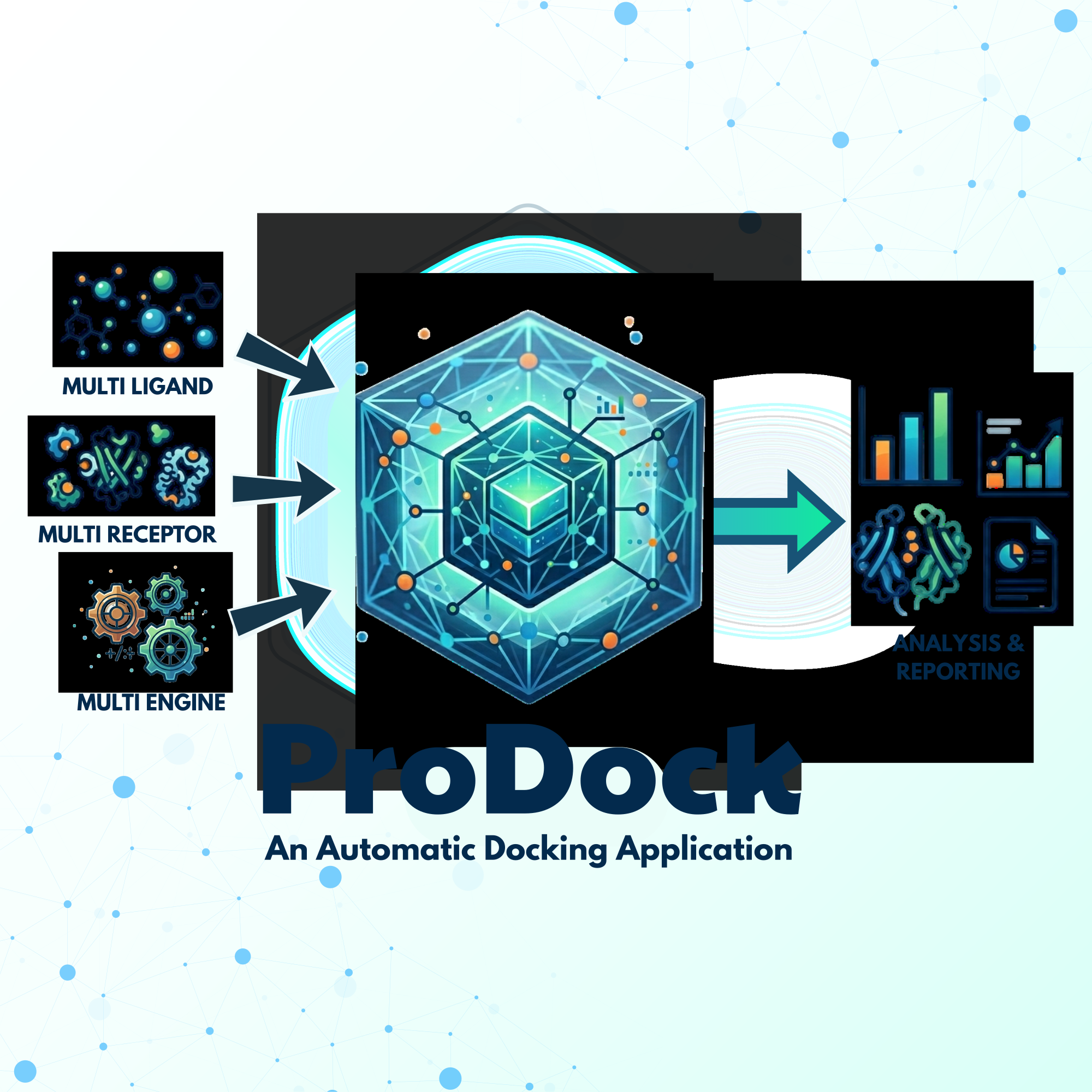
CLI#
The prodock.cli module provides a JSON-first command-line interface for
running end-to-end ProDock workflows. It is designed for reproducibility: a
single configuration file can define receptors, ligands, engine settings,
interaction extraction, and database export, while explicit command-line flags
can override selected run parameters without editing the base config.
Overview#
Config-driven
Store a full campaign in one JSON file for reproducible reruns and version control.
Override-friendly
Change engines, CPU, exhaustiveness, output database name, and other runtime options from the shell.
Validation-first
Input modes are checked before execution, including receptor mode and ligand mode consistency.
Pipeline-connected
The CLI normalizes user input and forwards it to the core prodock(...) workflow.
Quick start#
Run a full campaign from a JSON file:
python -m prodock --config run.json
Write a compact machine-readable run summary:
python -m prodock --config run.json --summary-json outputs/summary.json
Override selected runtime parameters from the shell:
python -m prodock \
    --config run.json \
    --engines qvina qvina-w smina \
    --cpu 8 \
    --n-jobs 8 \
    --exhaustiveness 16 \
    --n-poses 20 \
    --db-name campaign.sqlite
Configuration model#
The CLI supports two mutually exclusive receptor modes and two mutually exclusive ligand modes:
receptorsorprepared_receptorsligandsorligand_dir
A typical configuration file is:
{
  "project_dir": "Data/testcase/Multi",
  "receptors": [
    {
      "pdb_id": "4WKQ",
      "receptor_name": "EGFR_4WKQ",
      "ligand_code": "IRE",
      "chains": ["A"],
      "cofactors": []
    }
  ],
  "ligands": [
    {
      "id": "erlotinib",
      "smiles": "COCCOc1cc2c(ncnc2cc1OCCOC)Nc1cccc(c1)C#C"
    },
    {
      "id": "gefitinib",
      "smiles": "COc1cc2ncnc(c2cc1OCCCN1CCOCC1)Nc1ccc(c(c1)Cl)F"
    }
  ],
  "config": {
    "engines": ["qvina", "qvina-w"],
    "extract_interaction": true,
    "db_name": "test.db",
    "cpu": 8,
    "n_jobs": 8,
    "exhaustiveness": 16,
    "n_poses": 20
  }
}
The CLI also accepts nested runtime dictionaries under config, options,
or run. These are merged into one normalized argument dictionary before the
pipeline is called.
Common override patterns#
Switch to prepared receptors and a ligand directory in the base config, then override only the engines and database output:
python -m prodock \
    --config prepared_campaign.json \
    --engines vina smina \
    --db-name prepared.sqlite
Enable interaction extraction and keep the console output quiet except for the summary file:
python -m prodock \
    --config run.json \
    --extract-interaction \
    --summary-json reports/run_summary.json \
    --quiet
Request a traceback for debugging invalid or failing runs:
python -m prodock --config run.json --traceback
Notes#
Relative paths inside the JSON file are resolved relative to the config file location.
Explicit command-line flags take precedence over JSON-provided runtime options.
The CLI validates that exactly one receptor mode and exactly one ligand mode are selected.
The final return object is condensed into a JSON-serializable summary for console or file output.
Reference#
- exception CLIError#
Bases:
ValueErrorRaised when CLI input or config structure is invalid.