Core API#
- class PreparedReceptorSpec(receptor_id, receptor_pdbqt, center, size)#
Bases:
objectFully prepared receptor definition ready for campaign construction.
- Parameters:
receptor_id (str) – Unique receptor identifier used inside the docking campaign.
receptor_pdbqt (Path) – Path to the final receptor
.pdbqtfile.center (Vec3) – Docking box center as
(x, y, z).size (Vec3) – Docking box size as
(sx, sy, sz).
- class ProDockResult(
- project_dir,
- ligand_dir,
- campaign_json,
- receptors,
- receptor_pdb_by_id,
- campaign,
- docking_results,
- pose_df,
- interaction_result,
- merged_df,
- interaction_df,
- summary_df,
- compact_interactions,
- db_path,
Bases:
objectStructured result bundle returned by
ProDockPipeline.- Parameters:
project_dir (Path) – Root working directory of the project.
ligand_dir (Path) – Directory containing final ligand files used by the campaign.
campaign_json (Path) – Path to the generated campaign JSON file.
receptors (List[PreparedReceptorSpec]) – Prepared receptor specifications included in the campaign.
receptor_pdb_by_id (Dict[str, Path]) – Mapping from receptor identifier to receptor
.pdbfile used for interaction analysis.campaign (Campaign) – In-memory campaign object.
docking_results (Any) – Raw docking results returned by
prodock.dock.BatchDock.pose_df (pandas.DataFrame) – Pose table collected by
prodock.postprocess.pose.PoseCrawler.interaction_result (Any) – Raw interaction extraction result object, or
Noneif interaction extraction was skipped.merged_df (pandas.DataFrame) – Final dataframe chosen for downstream insertion into the database. This is the interaction-merged dataframe if interaction extraction is enabled; otherwise it is the crawled pose dataframe.
interaction_df (Optional[pandas.DataFrame]) – Long-form interaction-event dataframe, or
None.summary_df (Optional[pandas.DataFrame]) – Pose-level interaction summary dataframe, or
None.compact_interactions (Optional[Dict[str, Any]]) – Compact per-pose interaction dictionary, or
None.db_path (Optional[Path]) – SQLite database path if database writing was enabled.
- receptors: List[PreparedReceptorSpec]#
- campaign: Campaign#
- pose_df: pandas.DataFrame#
- merged_df: pandas.DataFrame#
- class ProDockPipeline(
- project_dir,
- *,
- engines=None,
- cpu=4,
- seed=42,
- exhaustiveness=8,
- n_poses=10,
- n_jobs=None,
- progress=True,
- receptor_use_meeko=False,
- ligand_output_format='pdbqt',
- ligand_backend='meeko',
- box_scale=2.0,
- box_isotropic=True,
- campaign_name='campaign.json',
- log_file='prodock.log',
- log_level='INFO',
- log_colored=True,
- log_json=False,
Bases:
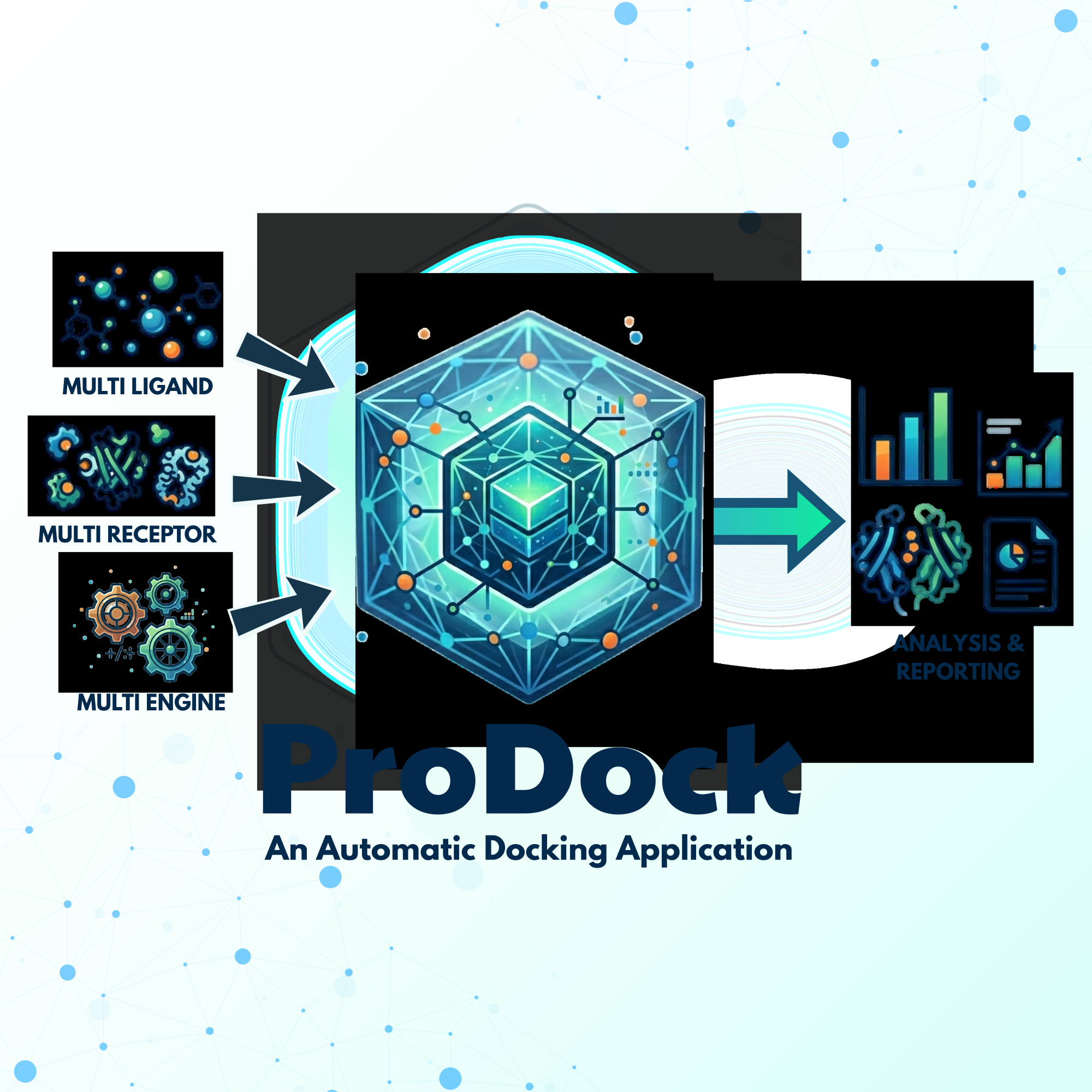
objectHigh-level orchestration helper for ProDock projects.
This class provides a single automation entry point for common workflows:
raw receptor records + ligand SMILES records
prebuilt receptor
.pdbqtfiles + explicit docking box coordinatesoptional pose crawling after docking
optional interaction extraction
optional database creation and insertion
All generated data are organized under
project_dir.- Parameters:
project_dir (PathLike) – Root directory used for all generated project files.
engines (Optional[Sequence[str]]) – Docking engines to include in the campaign. Default is
["smina", "qvina"].cpu (int) – Per-engine CPU setting stored in the campaign.
seed (int) – Random seed stored in the campaign.
exhaustiveness (int) – Exhaustiveness stored in the campaign.
n_poses (int) – Number of poses stored in the campaign.
n_jobs (Optional[int]) – Number of parallel jobs used by
BatchDock. IfNone, this defaults tocpu.progress (bool) – Whether to enable progress reporting in
BatchDock.receptor_use_meeko (bool) – Whether receptor preparation should use Meeko.
ligand_output_format (str) – Final ligand output format.
ligand_backend (str) – Ligand conversion backend used by
LigandPrep.box_scale (float) – Scale factor used when computing a grid box from a reference ligand.
box_isotropic (bool) – Whether ligand-derived boxes should be isotropic.
campaign_name (str) – Default campaign JSON file name.
log_file (str)
log_colored (bool)
log_json (bool)
Example#
pipeline = ProDockPipeline("Data/testcase/Multi")
result = pipeline.run(
    receptors=RECEPTORS,
    ligands=LIGANDS,
    extract_interaction=True,
)
print(result.campaign_json)
print(result.db_path)
Example#
pipeline = ProDockPipeline("Data/testcase/Multi")
result = pipeline.run(
    prepared_receptors=[
        {
            "receptor_id": "4WKQ",
            "receptor_pdbqt": "Data/testcase/Multi/4WKQ/filtered_protein/4WKQ.pdbqt",
            "center": (2.865, 193.257, 21.367),
            "size": (27.091, 27.091, 27.091),
        }
    ],
    ligand_dir="Data/testcase/Multi/ligands",
    extract_interaction=True,
)
print(result.receptor_pdb_by_id)
- prepare_receptors(*, receptors=None, prepared_receptors=None)#
Prepare receptor inputs for campaign construction.
Exactly one receptor input mode must be supplied:
receptorsfor raw PDB-queryable receptorsprepared_receptorsfor already prepared receptor.pdbqtfiles
Raw mode will:
call
PDBQuery.process_batch()prepare receptor
.pdbto.pdbqtderive box coordinates from explicit box values or a reference ligand
Prepared mode will only validate and normalize the provided paths and box definitions.
- Parameters:
- Returns:
Normalized prepared receptor specifications.
- Return type:
List[PreparedReceptorSpec]
- Raises:
ValueError – Raised if both receptor modes are provided or if neither is provided.
FileNotFoundError – Raised if an expected receptor or reference-ligand file is missing.
Example#
receptor_specs = pipeline.prepare_receptors(
    receptors=RECEPTORS
)
Example#
receptor_specs = pipeline.prepare_receptors(
    prepared_receptors=[
        {
            "receptor_id": "4WKQ",
            "receptor_pdbqt": "Data/testcase/Multi/4WKQ/filtered_protein/4WKQ.pdbqt",
            "center": (2.865, 193.257, 21.367),
            "size": (27.091, 27.091, 27.091),
        }
    ]
)
- prepare_ligands(*, ligands=None, ligand_dir=None)#
Prepare or resolve ligand inputs.
Exactly one ligand input mode must be supplied:
ligandsas a list of SMILES recordsligand_diras an existing directory of prepared ligands
When
ligandsis used, the output directory defaults to<project_dir>/ligands.- Parameters:
- Returns:
Absolute path to the ligand directory used by the campaign.
- Return type:
Path
- Raises:
ValueError – Raised if both ligand modes are provided or if neither is provided.
FileNotFoundError – Raised if the provided ligand directory does not exist.
NotADirectoryError – Raised if the provided ligand path is not a directory.
Example#
ligand_dir = pipeline.prepare_ligands(
    ligands=LIGANDS
)
Example#
ligand_dir = pipeline.prepare_ligands(
    ligand_dir="Data/testcase/Multi/ligands"
)
- build_campaign(*, receptor_specs, ligand_dir)#
Build a
Campaignfrom prepared receptors and ligands.- Parameters:
receptor_specs (Sequence[PreparedReceptorSpec]) – Prepared receptor specifications.
ligand_dir (PathLike) – Directory containing final ligand files.
- Returns:
Campaign object ready to be serialized or executed.
- Return type:
Campaign
Example#
campaign = pipeline.build_campaign(
    receptor_specs=receptor_specs,
    ligand_dir=ligand_dir,
)
print(campaign)
- save_campaign(campaign, *, campaign_name=None)#
Save a campaign JSON file under the project directory.
- Parameters:
campaign (Campaign) – Campaign instance to serialize.
campaign_name (Optional[str]) – Output JSON file name. If
None, the pipeline default is used.
- Returns:
Path to the written JSON file.
- Return type:
Path
Example#
campaign_json = pipeline.save_campaign(campaign)
print(campaign_json)
- crawl_poses(*, backend='auto')#
Crawl docked poses from the project directory.
This wraps
prodock.postprocess.pose.PoseCrawlerusing the pipeline project directory as the crawl root.- Parameters:
backend (str) – Molecule loading backend passed to
PoseCrawler.crawl_mols().- Returns:
Crawled pose dataframe.
- Return type:
pandas.DataFrame
Example#
pose_df = pipeline.crawl_poses(backend="obabel")
print(pose_df.head())
- extract_interactions(
- *,
- poses,
- receptor_specs,
- batch_size=1,
- progress=False,
- n_jobs=1,
- include_fingerprint_columns=True,
- include_interaction_events=True,
- include_bitvectors=False,
- include_countvectors=False,
- fail_fast=True,
- use_profiler=False,
Extract protein-ligand interactions from a crawled pose dataframe.
The receptor
.pdbmapping is automatically derived from the prepared receptor.pdbqtfiles by replacing.pdbqtwith.pdb.By default this method uses
extract_pose_table_interactions(). Optionally, it can useInteractionProfiler.- Parameters:
poses (pandas.DataFrame) – Pose dataframe returned by
crawl_poses().receptor_specs (Sequence[PreparedReceptorSpec]) – Prepared receptor specifications.
batch_size (int) – Batch size for interaction extraction.
progress (bool) – Whether to show progress.
n_jobs (int) – Number of parallel jobs.
include_fingerprint_columns (bool) – Whether to include fingerprint columns.
include_interaction_events (bool) – Whether to include the long-form interaction-event dataframe.
include_bitvectors (bool) – Whether to include bitvectors.
include_countvectors (bool) – Whether to include countvectors.
fail_fast (bool) – Whether to fail on the first extraction error.
use_profiler (bool) – Whether to use
InteractionProfilerinstead of the functional wrapper.
- Returns:
Tuple
(interaction_result, receptor_pdb_by_id).- Return type:
Tuple[Any, Dict[str, Path]]
Example#
interaction_result, receptor_pdb_by_id = pipeline.extract_interactions(
    poses=pose_df,
    receptor_specs=receptor_specs,
    batch_size=1,
    progress=False,
    n_jobs=1,
)

merged_df = interaction_result.merged_df
interaction_df = interaction_result.interaction_df
summary_df = interaction_result.summary_df
compact = interaction_result.summary_dict(kind="compact")
- save_database(
- *,
- df,
- interactions_by_pose=None,
- db_name='prodock.db',
- replace=True,
- replace_interactions=True,
Create or update a project-local SQLite database and insert results.
Relative database names are created inside
project_dir. With the default configuration, the database path is:<project_dir>/prodock.db
- Parameters:
df (pandas.DataFrame) – Dataframe to insert.
interactions_by_pose (Optional[Dict[str, Any]]) – Optional compact interaction dictionary keyed by pose identifier.
db_name (PathLike) – Database filename or relative path under
project_dir.replace (bool) – Whether to replace existing pose rows.
replace_interactions (bool) – Whether to replace existing interaction rows.
- Returns:
Absolute path to the SQLite database.
- Return type:
Path
Example#
db_path = pipeline.save_database(
    df=merged_df,
    interactions_by_pose=compact,
    db_name="prodock.db",
)
print(db_path)
- run(
- *,
- receptors=None,
- prepared_receptors=None,
- ligands=None,
- ligand_dir=None,
- campaign_name=None,
- crawl_backend='backend',
- extract_interaction=False,
- interaction_batch_size=1,
- interaction_progress=False,
- interaction_n_jobs=1,
- include_fingerprint_columns=True,
- include_interaction_events=True,
- include_bitvectors=False,
- include_countvectors=False,
- fail_fast=True,
- use_interaction_profiler=False,
- save_to_database=True,
- db_name='prodock.db',
- replace=True,
- replace_interactions=True,
Execute the full ProDock pipeline.
This method performs the full end-to-end automation:
prepare or validate receptors
prepare or resolve ligands
build and save the campaign JSON
run batch docking
run pose crawling on the project directory
optionally extract interactions
optionally create
<project_dir>/prodock.dband insert results
- Parameters:
receptors (Optional[List[Dict[str, Any]]]) – Raw receptor records for full receptor acquisition and preparation mode.
prepared_receptors (Optional[List[Dict[str, Any]]]) – Already prepared receptor records for direct docking mode.
ligands (Optional[List[Dict[str, str]]]) – Ligand SMILES records for ligand preparation mode.
ligand_dir (Optional[PathLike]) – Existing prepared ligand directory for direct docking mode.
campaign_name (Optional[str]) – Output campaign JSON file name.
crawl_backend (str) – Backend passed to
crawl_poses().extract_interaction (bool) – Whether to run interaction extraction after pose crawling.
interaction_batch_size (int) – Interaction extraction batch size.
interaction_progress (bool) – Whether to show progress during interaction extraction.
interaction_n_jobs (int) – Parallel jobs for interaction extraction.
include_fingerprint_columns (bool) – Whether to include fingerprint columns in interaction output.
include_interaction_events (bool) – Whether to include long-form interaction events.
include_bitvectors (bool) – Whether to include bitvectors.
include_countvectors (bool) – Whether to include countvectors.
fail_fast (bool) – Whether interaction extraction should fail immediately on errors.
use_interaction_profiler (bool) – Whether to use
InteractionProfilerfor interaction extraction.save_to_database (bool) – Whether to create or update the SQLite database and insert results.
db_name (PathLike) – Database filename or relative path under
project_dir.replace (bool) – Whether database insertion should replace existing pose rows.
replace_interactions (bool) – Whether database insertion should replace existing interaction rows.
- Returns:
Structured pipeline result.
- Return type:
Example#
result = pipeline.run(
    receptors=RECEPTORS,
    ligands=LIGANDS,
    extract_interaction=True,
    db_name="prodock.db",
)

print(result.campaign_json)
print(result.db_path)
print(result.pose_df.head())
print(result.merged_df.head())
Example#
result = pipeline.run(
    prepared_receptors=[
        {
            "receptor_id": "4WKQ",
            "receptor_pdbqt": "Data/testcase/Multi/4WKQ/filtered_protein/4WKQ.pdbqt",
            "center": (2.865, 193.257, 21.367),
            "size": (27.091, 27.091, 27.091),
        }
    ],
    ligand_dir="Data/testcase/Multi/ligands",
    extract_interaction=True,
    interaction_batch_size=1,
    interaction_n_jobs=1,
)
- prodock(
- project_dir,
- *,
- receptors=None,
- prepared_receptors=None,
- ligands=None,
- ligand_dir=None,
- engines=None,
- cpu=4,
- seed=42,
- exhaustiveness=8,
- n_poses=10,
- n_jobs=None,
- progress=True,
- receptor_use_meeko=False,
- ligand_output_format='pdbqt',
- ligand_backend='meeko',
- box_scale=2.0,
- box_isotropic=True,
- campaign_name='campaign.json',
- crawl_backend='auto',
- extract_interaction=False,
- interaction_batch_size=1,
- interaction_progress=False,
- interaction_n_jobs=1,
- include_fingerprint_columns=True,
- include_interaction_events=True,
- include_bitvectors=False,
- include_countvectors=False,
- fail_fast=True,
- use_interaction_profiler=False,
- save_to_database=True,
- db_name='prodock.db',
- replace=True,
- replace_interactions=True,
- log_file='prodock.log',
- log_level='INFO',
- log_colored=True,
- log_json=False,
Functional wrapper around
ProDockPipeline.This is the main convenience entry point for running a complete ProDock workflow in one call.
- Parameters:
project_dir (PathLike) – Root project directory.
receptors (Optional[List[Dict[str, Any]]]) – Raw receptor records.
prepared_receptors (Optional[List[Dict[str, Any]]]) – Already prepared receptor records.
ligands (Optional[List[Dict[str, str]]]) – Ligand SMILES records.
ligand_dir (Optional[PathLike]) – Existing ligand directory.
engines (Optional[Sequence[str]]) – Docking engines to include. Default is
["smina", "qvina"].cpu (int) – CPU value stored in the campaign.
seed (int) – Random seed stored in the campaign.
exhaustiveness (int) – Exhaustiveness stored in the campaign.
n_poses (int) – Number of poses stored in the campaign.
n_jobs (Optional[int]) – Parallel jobs used by
BatchDock.progress (bool) – Whether to enable docking progress reporting.
receptor_use_meeko (bool) – Whether receptor preparation uses Meeko.
ligand_output_format (str) – Final ligand output format.
ligand_backend (str) – Ligand conversion backend.
box_scale (float) – Box scale factor used for ligand-derived boxes.
box_isotropic (bool) – Whether ligand-derived boxes are isotropic.
campaign_name (str) – Output campaign JSON file name.
crawl_backend (str) – Pose crawler backend.
extract_interaction (bool) – Whether to run interaction extraction.
interaction_batch_size (int) – Interaction extraction batch size.
interaction_progress (bool) – Whether to show interaction extraction progress.
interaction_n_jobs (int) – Parallel jobs for interaction extraction.
include_fingerprint_columns (bool) – Whether to include fingerprint columns.
include_interaction_events (bool) – Whether to include long-form interaction events.
include_bitvectors (bool) – Whether to include bitvectors.
include_countvectors (bool) – Whether to include countvectors.
fail_fast (bool) – Whether interaction extraction fails immediately on errors.
use_interaction_profiler (bool) – Whether to use
InteractionProfiler.save_to_database (bool) – Whether to write results into the SQLite database.
db_name (PathLike) – Database filename or relative path under
project_dir.replace (bool) – Whether to replace existing pose rows in the database.
replace_interactions (bool) – Whether to replace existing interaction rows in the database.
log_file (str)
log_colored (bool)
log_json (bool)
- Returns:
Structured pipeline result.
- Return type:
Example#
from prodock import prodock

PROJECT = "Data/testcase/Multi"

RECEPTORS = [
    {
        "pdb_id": "4WKQ",
        "receptor_name": "EGFR_4WKQ",
        "ligand_code": "IRE",
        "chains": ["A"],
        "cofactors": [],
    },
]

LIGANDS = [
    {
        "id": "erlotinib",
        "smiles": "COCCOc1cc2c(ncnc2cc1OCCOC)Nc1cccc(c1)C#C",
    },
    {
        "id": "gefitinib",
        "smiles": "COc1cc2ncnc(c2cc1OCCCN1CCOCC1)Nc1ccc(c(c1)Cl)F",
    },
]

result = prodock(
    PROJECT,
    receptors=RECEPTORS,
    ligands=LIGANDS,
    engines=["smina"],
    extract_interaction=True,
    db_name="prodock.db",
)

print(result.campaign_json)
print(result.db_path)
print(result.receptor_pdb_by_id)
Example#
from prodock import prodock

PROJECT = "Data/testcase/Multi"

result = prodock(
    PROJECT,
    prepared_receptors=[
        {
            "receptor_id": "4WKQ",
            "receptor_pdbqt": "Data/testcase/Multi/4WKQ/filtered_protein/4WKQ.pdbqt",
            "center": (2.865, 193.257, 21.367),
            "size": (27.091, 27.091, 27.091),
        }
    ],
    ligand_dir="Data/testcase/Multi/ligands",
    extract_interaction=True,
    db_name="prodock.db",
)

print(result.summary_df.head())
- run_prodock(
- project_dir,
- *,
- receptors=None,
- prepared_receptors=None,
- ligands=None,
- ligand_dir=None,
- engines=None,
- cpu=4,
- seed=42,
- exhaustiveness=8,
- n_poses=10,
- n_jobs=None,
- progress=True,
- receptor_use_meeko=False,
- ligand_output_format='pdbqt',
- ligand_backend='meeko',
- box_scale=2.0,
- box_isotropic=True,
- campaign_name='campaign.json',
- crawl_backend='auto',
- extract_interaction=False,
- interaction_batch_size=1,
- interaction_progress=False,
- interaction_n_jobs=1,
- include_fingerprint_columns=True,
- include_interaction_events=True,
- include_bitvectors=False,
- include_countvectors=False,
- fail_fast=True,
- use_interaction_profiler=False,
- save_to_database=True,
- db_name='prodock.db',
- replace=True,
- replace_interactions=True,
- log_file='prodock.log',
- log_level='INFO',
- log_colored=True,
- log_json=False,
Functional wrapper around
ProDockPipeline.This is the main convenience entry point for running a complete ProDock workflow in one call.
- Parameters:
project_dir (PathLike) – Root project directory.
receptors (Optional[List[Dict[str, Any]]]) – Raw receptor records.
prepared_receptors (Optional[List[Dict[str, Any]]]) – Already prepared receptor records.
ligands (Optional[List[Dict[str, str]]]) – Ligand SMILES records.
ligand_dir (Optional[PathLike]) – Existing ligand directory.
engines (Optional[Sequence[str]]) – Docking engines to include. Default is
["smina", "qvina"].cpu (int) – CPU value stored in the campaign.
seed (int) – Random seed stored in the campaign.
exhaustiveness (int) – Exhaustiveness stored in the campaign.
n_poses (int) – Number of poses stored in the campaign.
n_jobs (Optional[int]) – Parallel jobs used by
BatchDock.progress (bool) – Whether to enable docking progress reporting.
receptor_use_meeko (bool) – Whether receptor preparation uses Meeko.
ligand_output_format (str) – Final ligand output format.
ligand_backend (str) – Ligand conversion backend.
box_scale (float) – Box scale factor used for ligand-derived boxes.
box_isotropic (bool) – Whether ligand-derived boxes are isotropic.
campaign_name (str) – Output campaign JSON file name.
crawl_backend (str) – Pose crawler backend.
extract_interaction (bool) – Whether to run interaction extraction.
interaction_batch_size (int) – Interaction extraction batch size.
interaction_progress (bool) – Whether to show interaction extraction progress.
interaction_n_jobs (int) – Parallel jobs for interaction extraction.
include_fingerprint_columns (bool) – Whether to include fingerprint columns.
include_interaction_events (bool) – Whether to include long-form interaction events.
include_bitvectors (bool) – Whether to include bitvectors.
include_countvectors (bool) – Whether to include countvectors.
fail_fast (bool) – Whether interaction extraction fails immediately on errors.
use_interaction_profiler (bool) – Whether to use
InteractionProfiler.save_to_database (bool) – Whether to write results into the SQLite database.
db_name (PathLike) – Database filename or relative path under
project_dir.replace (bool) – Whether to replace existing pose rows in the database.
replace_interactions (bool) – Whether to replace existing interaction rows in the database.
log_file (str)
log_colored (bool)
log_json (bool)
- Returns:
Structured pipeline result.
- Return type:
Example#
from prodock import prodock

PROJECT = "Data/testcase/Multi"

RECEPTORS = [
    {
        "pdb_id": "4WKQ",
        "receptor_name": "EGFR_4WKQ",
        "ligand_code": "IRE",
        "chains": ["A"],
        "cofactors": [],
    },
]

LIGANDS = [
    {
        "id": "erlotinib",
        "smiles": "COCCOc1cc2c(ncnc2cc1OCCOC)Nc1cccc(c1)C#C",
    },
    {
        "id": "gefitinib",
        "smiles": "COc1cc2ncnc(c2cc1OCCCN1CCOCC1)Nc1ccc(c(c1)Cl)F",
    },
]

result = prodock(
    PROJECT,
    receptors=RECEPTORS,
    ligands=LIGANDS,
    engines=["smina"],
    extract_interaction=True,
    db_name="prodock.db",
)

print(result.campaign_json)
print(result.db_path)
print(result.receptor_pdb_by_id)
Example#
from prodock import prodock

PROJECT = "Data/testcase/Multi"

result = prodock(
    PROJECT,
    prepared_receptors=[
        {
            "receptor_id": "4WKQ",
            "receptor_pdbqt": "Data/testcase/Multi/4WKQ/filtered_protein/4WKQ.pdbqt",
            "center": (2.865, 193.257, 21.367),
            "size": (27.091, 27.091, 27.091),
        }
    ],
    ligand_dir="Data/testcase/Multi/ligands",
    extract_interaction=True,
    db_name="prodock.db",
)

print(result.summary_df.head())